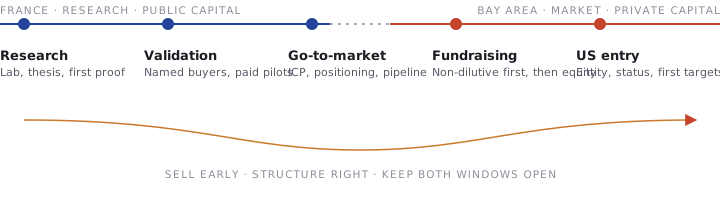
The path, in one line
I built these tools because the same questions kept coming back. Every founder conversation about the US raised them. Answering them one at a time on calls didn't scale. Work through them honestly; the useful outcome is often "not yet", and that's a good answer, not a failure. Going too early is how deeptech companies run out of money.
Free simulator
Before the US question, check what the French public side could give you. Five questions, a first map of grants, tax credits and loans.
Where this sits: the Playbook is for understanding the terrain and the method. These tools are for testing your own readiness against it. And if you want to work through your actual case, that is what I do with founders.
Should we raise in Europe or the US?
Do we need a US entity yet?
Should we move now, or validate first?
What kind of investor should we actually target?
The path, in one line
Is there a real, sizeable US market for what you build, or are you assuming one because the US is big?
Can you name three American companies that would buy this, and say why they'd switch from what they use today?
Is your differentiation real in the US context, where the competitive set is different from Europe?
Do you have at least 12 months of runway that doesn't depend on the US working?
What are you actually trying to do right now?
Has a customer or investor explicitly told you a US entity is required?
Where does your IP sit, and would moving it jeopardize CIR, JEI or existing grants?
Who is your buyer?
What matters more in the next 18 months?
Four scenarios, from testing the market without leaving France to a full local presence. The line items are the ones that actually appear; the numbers are yours to fill in. Nothing here is pre-filled, because no two deeptech companies have the same cost structure.
No entity, no relocation. You test whether anyone in the US actually wants this. Twelve months.
| Line | Low | Base | High |
|---|---|---|---|
| Travel, 3 to 4 trips | |||
| Conferences and events | |||
| Market research and data | |||
| Localized collateral and site | |||
| Advisory or fractional support | |||
| Total | — | — | — |
Still no entity. You're selling: discovery calls, pilots, a first paid contract invoiced from France.
| Line | Low | Base | High |
|---|---|---|---|
| Travel, 6 to 8 trips | |||
| Conferences, booth or speaking | |||
| Sales tooling and data | |||
| Pilot delivery cost | |||
| Contracts reviewed by US counsel | |||
| Insurance and compliance | |||
| Total | — | — | — |
A US entity exists and someone is on the ground. First full year including setup.
| Line | Low | Base | High |
|---|---|---|---|
| Incorporation and legal setup | |||
| Registered agent and state fees | |||
| US accounting and tax filings | |||
| First hire, fully loaded | |||
| Immigration, legal and filing fees | |||
| Payroll, benefits, insurance | |||
| Workspace | |||
| Travel and founder time | |||
| Total | — | — | — |
A real local team. Add the transatlantic structure cost most founders forget to price.
| Line | Low | Base | High |
|---|---|---|---|
| Team, 3 to 5 people loaded | |||
| Office and operations | |||
| Legal, corporate and IP | |||
| Transfer pricing and cross-border tax | |||
| Marketing and demand generation | |||
| Immigration, ongoing | |||
| Insurance, D&O, compliance | |||
| Total | — | — | — |
Fill in your own figures. The calculation updates as you type.
The main routes French founders actually use, what each one allows, and what it costs to file.
Visa, status and work authorization are three different things. A valid visa lets you request admission. Status is the set of conditions you were admitted under. Work authorization is separate again. People conflate them constantly, and that's where most avoidable problems start.
| Route | Who it fits | Core condition | Can you work? | Government fees | Green card path |
|---|---|---|---|---|---|
| ESTA | Short business trips, conferences, meetings | French passport, no visa needed, stays up to 90 days | No. Meetings and negotiation only, no productive work | Low, application fee only | No |
| B-1 | Business visitors needing more than ESTA allows | Consular interview, demonstrated intent to return | No. Same restriction as ESTA | Consular application fee | No |
| O-1 | Founders and specialists with a documented record | Extraordinary ability, evidenced. No lottery, no annual cap | Yes, for the petitioning employer or agent | I-129 base filing plus category fees. Premium processing $2,805 optional | Yes, commonly via EB-1A |
| E-2 | Founders investing in a US business | Treaty investor. France qualifies. Substantial investment, at-risk capital | Yes, in the invested business | Consular fees, plus legal and structuring cost | No direct path |
| L-1 | Transferring from your French company to a US entity | One year of qualifying employment abroad in the prior three. Requires a related US entity | Yes, for the petitioning employer | Government fees generally $1,195 to $2,485 for an initial individual petition, depending on employer profile | Yes, L-1A commonly via EB-1C |
| H-1B | Employees joining a US company in a specialty occupation | Annual lottery. Sponsoring employer required. Registration window in March | Yes, for the petitioning employer | $215 registration, plus I-129 and statutory surcharges. Roughly $2,880 to $6,880 in USCIS fees for a mid-size employer before premium processing | Yes, employer-sponsored |
The right question isn't "which visa can I get" but "what am I actually trying to do". Selling remotely, attending a conference, hiring a US employee and relocating yourself are four different problems with four different answers.
The evidentiary bar is high: publications, press, awards, judging, measurable impact. Building that case takes eighteen months or more. Founders who look at O-1 only when they need it have already lost the window.
You need a year of qualifying employment abroad and a genuine corporate relationship between the two entities. It can't be assembled retroactively.
Registration happens in March for an October start. Selection isn't guaranteed. Building a US launch timeline that depends on winning it's a planning error.
This page provides general information based on public sources and personal experience. It's not legal, immigration or tax advice, and it doesn't create an attorney-client relationship. Immigration outcomes depend on facts specific to each case. Consult a qualified US immigration attorney before acting.
Government fees and filing rules on this page were last checked in September 2026. If a figure looks wrong, it probably moved: tell me and I'll fix it.
Three ways the crossing tends to unfold, depending on what you build and who buys it.
If one of these resembles your situation, the details are where it gets useful. Book a meeting