Back in France now, and torn between two pulls. On one side, the pleasure of being home, a social life that's simply more fulfilling, friends and family within reach. On the other, a quiet FOMO whenever the tech news scrolls by: the sense of falling a step behind on some of the biggest questions humanity is living through right now.
There's a version of this story that fits on a LinkedIn slide. Tennis scholarship in the Bay Area, two master's degrees, an investment club, a co-founded startup, a playbook. Clean, linear, a little flattering.
Then there's the real one, the one worth telling. Made of back-and-forths, doors that stayed shut, meetings where half the codes went over my head, and one question that ended up organizing everything: why is France so good at giving birth to deeptech companies, and so bad at helping them grow, and what does that change, concretely, for a founder aiming at the United States?
That's what these notes are. A junior journey, seen from the bottom rung, told in sections so each piece stands on its own. It's a work in progress: more will be added over time.
§1Choosing the United States
The move came through an unexpected door: tennis. After a Master's at Mines Paris, a scholarship opened the way to do research in the US and play NCAA Division II, earned on the back of sixteen years of competitive tennis. A year runs around 110k USD; my agency negotiated a 70% scholarship. With the STEM OPT now approved, the plan is set: head back to build there.
Curious about the A-to-Z method behind this move? Ask by email.
§2Landing on the ground
Arrival came with one strong conviction: make the most of every week, find work, and build a network from zero. No safety net, no local reputation, just the decision to show up everywhere and be useful before asking for anything.
§3Networking and the Mines thesis
A long series of interviews for the Mines thesis turned into an education in itself. One lesson stood out: media and podcasts are networking gold. A LinkedIn message asking for a coffee because of a podcast or a piece of research lands very differently from a cold ask, roughly 50% more positive replies. A coffee is hard to refuse; a direct request for an internship is easy to ignore.
§4Silicon Valley Immersion
The Silicon Valley Immersion, Menlo's signature program (cohort 10), drops students straight inside the Valley's ecosystem. On paper: business analytics as leading firms practice it, quantitative critical thinking (framing the question before chasing the data), executive decision-making, global trends. In practice: meeting rooms, questions put to the people who actually decide, and a contact log that grew by the day. In a few weeks the cohort walked through Google, Microsoft, Cisco, NASA Ames and the Silicon Valley AI Hub, after Bloomberg, Snowflake and Autodesk earlier in the year. Seeing these machines from the inside, a few miles apart, changes something physical in how you read the terrain.


§5The Venture Series
Co-founding the Venture Series of the Menlo Investment Club came from a simple observation: plenty of students sitting inside the world's most dynamic ecosystem couldn't tell you the difference between VC and M&A. The club's mission was explicit, empower the next generation of investors and founders, through real exposure to venture capital and private equity, mentorship, and a mindset rooted in growth. In practice: a full semester curriculum taught week by week, private equity and the psychology of money, how VC funds scale startups, career mapping, personal branding, a finance-firm field trip, a networking clinic, and a closing Pitch Night, each session paired with a book of the week, plus guest speakers and introductions. Same logic as the thesis, lead with value: bring people something worth their time, and the network builds itself.


§6Co-founding a company remotely
One of the two ventures was built and run largely at a distance. Time zones, async work, trust across a screen, it forced a discipline most co-founding teams never have to learn. Deliverables still shipped on the promised dates, because organization replaced proximity. What made distance workable was a single habit: writing everything down. Decisions, specs, next steps, all captured async so no one waited on a call to move. We shipped what we promised, financing decks, CRM, pricing, on the dates we set, from three different time zones.
§7Discovering academic research
What began as a thesis turned into research in the full sense. With Dr. Faten Ben Bouheni, a first paper on the risk-return profiles of VC-backed firms, now published on SSRN (42 pages, June 2026), presented at a conference in Oakland, and picked up by VC funds before it was formally out. A second is in progress on Europe's scale-up gap, and a third, with Amine Lahiani, on whether accessible AI can help European DeepTech industrialize. Field conviction became a testable hypothesis: European founders are better off entering the US market earlier.
Read the SSRN paper → · See all my work →
§8Taking part in, and running, events
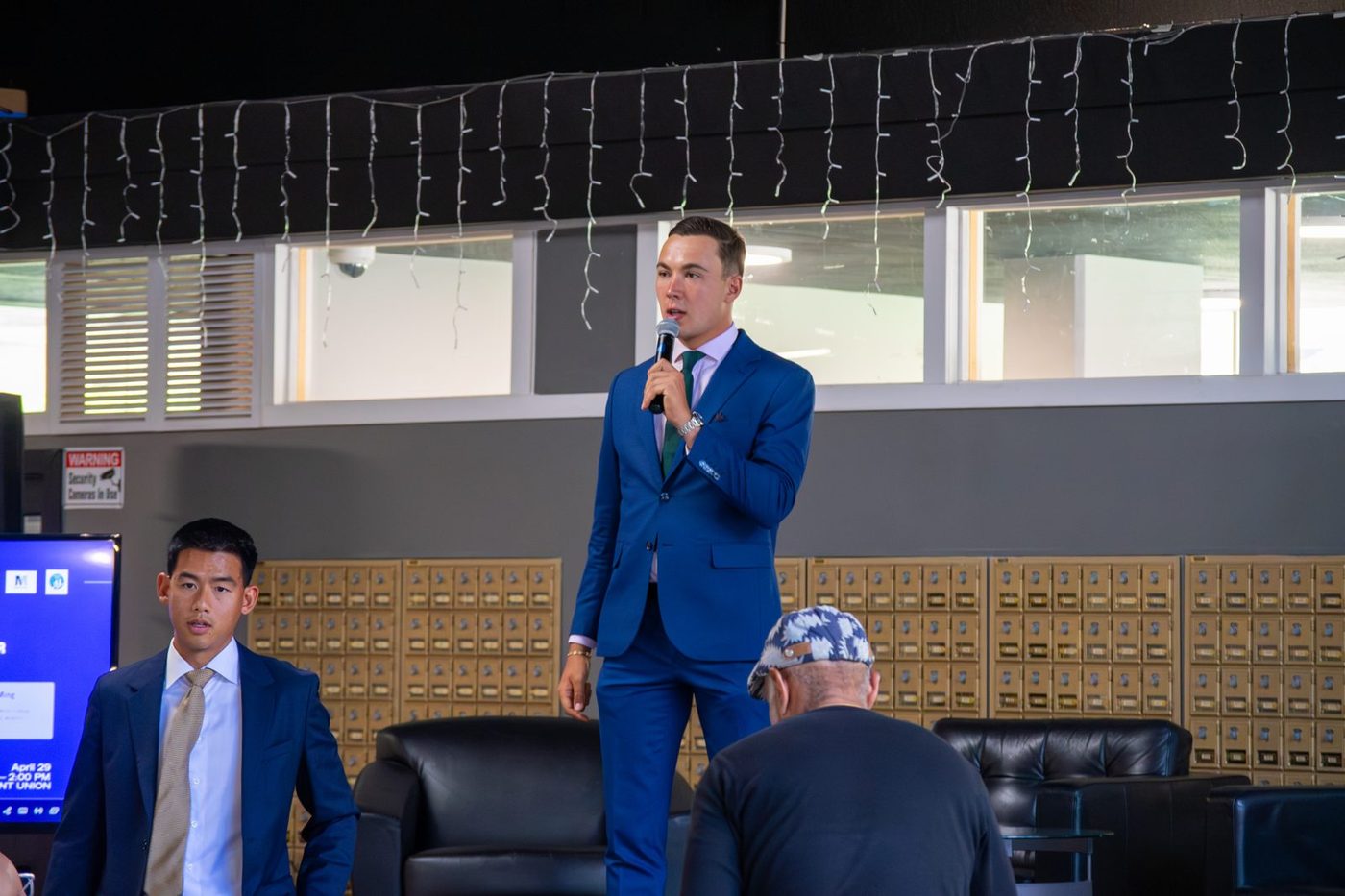
Beyond the club, there were events on both sides: volunteering to help make French Tech known in the Bay Area, and organizing gatherings to meet the ecosystem face to face. Talks and panels followed, at EDHEC, at Kedge Business School in Marseille, within the Silicon Valley Immersion, at the Finance Hybrid Conference at Menlo, and as a speaker at the Tech & Talk Summit alongside Sabeer Bhatia, Patrick Eibl and Robinson Pelluault. Same exercise each time: present the work, defend it in front of people who push back.
§9Getting close to the French community in SF
Twelve thousand kilometers from home, the French community in San Francisco turned out to be a piece of home, French Tech, alumni, founders who'd made the same crossing. It softened the distance and opened doors at the same time. The French Tech events were the anchor point, a room where the accent, the references and the ambition all lined up, and where a stranger became a contact in one conversation. Twelve thousand kilometers out, that familiarity was worth more than any introduction.
§10The athlete's life
Before finance, there was tennis, and it shaped everything that followed. Two sports at a competitive level, a season that read 25 matches · 16 W / 8 L / 1 draw · 64% wins. Sport taught the things advisory actually runs on: reading an opponent, staying level when a point turns, showing up on the days you don't feel like it. A raise is a match, momentum, nerves, and the discipline to keep serving. A short video on that tennis life is in the works; it will live here once the edit is done.
§11Travels and discovering California
Between matches came the country itself: national parks visited, states crossed, a calendar packed end to end. California first, then well beyond. The road trips were where the year decompressed, long drives, no agenda, the country going by. Seeing that much in so little time still surprises me looking back. [Name the parks and the road-trip route here, and add photos, this section is built to hold them.]
§12Social life in San Francisco
The energy is the thing people underestimate. Every event, every meetup, an intensity that's hard to describe until you're in it, the people met out there were extraordinary. What surprised me most was the openness, people genuinely curious, quick to help, quick to connect you onward. Ambition here is social rather than guarded, and that changes how fast things happen.
§13Taking part in a podcast
One of the best networking moves turned out to be the simplest: showing up on a podcast. It gives you a reason to reach out, something to share, and a warm way into conversations that would otherwise start cold.
§14Classes, the American way
The American classroom runs on a different engine: case-driven, participative, graded on contribution as much as exams, business analytics and quantitative reasoning taught as tools you use rather than theory you memorize. It reshaped how I frame a problem, question first, data second. The sharpest contrast with the French system: participation counts. Speaking up, challenging the case, bringing an angle, all of it is graded and expected, where French training rewards the polished final answer. You learn to think out loud, and to be wrong in public without it being fatal.
§15Networking, through tennis and beyond
The throughline of the whole year. Tennis opened the first door, then podcasts, research, events and the club each opened more. The lesson that kept proving itself: the network gets built before you need it, and warm always beats cold. Every open door traced back to someone met months earlier, asking for nothing. That's how a spreadsheet of contacts eventually became a database several thousand lines long.
§16I learned to code, and it changed everything
Somewhere in the middle of all this came building instead of just asking. Not to become a developer, but because the fastest way to solve a problem turned out to be code. Vibe-coding: describe what you want in plain language, let AI draft it, then read, fix, and shape it into something real.
The starting point: spreadsheets and a lot of frustration. The network lived in a tangle of tabs, duplicated, disconnected, unsearchable. It worked, barely, and it didn't scale.
The CRM today: all the data in one place. Rebuilt into one consolidated system, thousands of contacts, deduplicated, tagged by type, zone, tie strength, and how each was met, with a live priority score and a dashboard. A graveyard of tabs became a tool worth opening every morning.
The AI layer: adding intelligence. Then a brain on top, ranking who to reach out to, drafting the first message, remembering when to follow up. The gap between "I wish this existed" and "it exists" collapsed, the single most useful skill of the year. A concrete example: rebuilding the tangled contact spreadsheets into a working, deduplicated CRM with a live priority score, an afternoon of vibe-coding for something that would have meant weeks of manual work, or an outsourced dev, a year earlier.
§17Why I write
The playbook gives the method. These notes give the lived part, what it actually feels like to land with no status, no network, and rebuild. Written in real time rather than reconstructed later and tidied up, because the move to San Francisco is still ahead, not behind. More sections will be added as the story continues.
Originally shared on LinkedIn
These field notes go on LinkedIn first. Read the announcement and join the conversation →